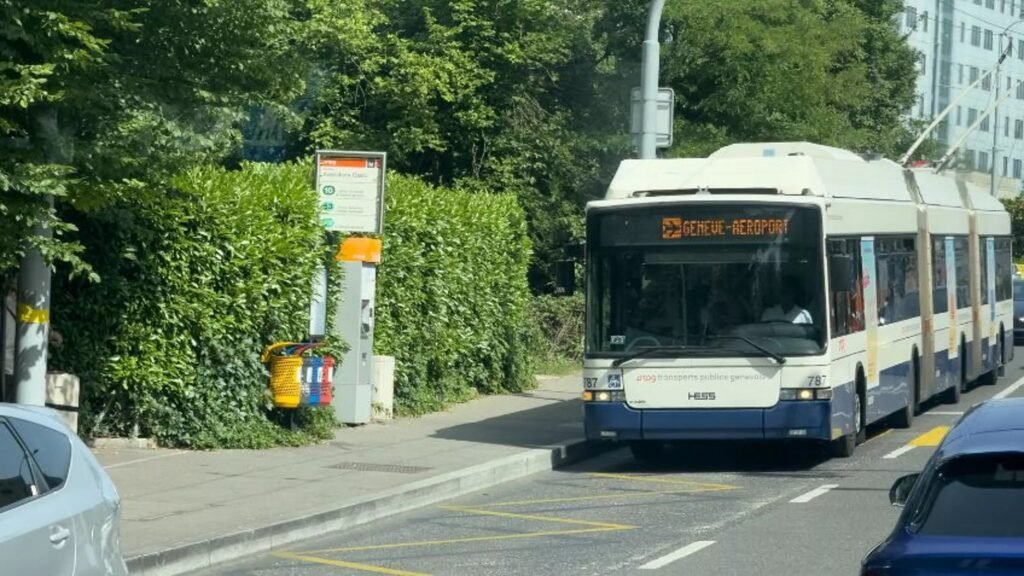
Spotted: Cities across Europe are racing to electrify bus fleets, but charging remains a sticking point. Relying mainly on overnight depot charging, as most fleets currently do, can force operators to install large batteries and expensive grid connections, driving up both vehicle cost and peak electricity demand.
By contrast, quasi-dynamic wireless charging along routes has been shown to reduce required battery capacity and spread loads more evenly, especially for high-frequency services. ETH Zurich spin-off Winduction is building on this idea with a wireless charging system that sends power from the road directly into vehicle wheels, and they are starting with public buses.
Instead of pantographs (overhead mechanical apparatuses), plug-in fast chargers, or overhead wires, Winduction embeds charging elements in the road at places where vehicles already stop, such as bus stops or terminal stands. Matching receivers are integrated into the wheels of the vehicle.
When a compatible bus pulls in and halts, power transfers wirelessly across the small gap between the road hardware and the wheel modules, topping up the battery without any cables or visible infrastructure. Because charging is tied to the route and timetable, operators can design patterns where buses pick up energy repeatedly through the day, rather than returning to depots for long, high-power sessions.
The company is targeting fleets with intense daily use, fixed routes, and predictable stopping points: urban buses, depot or airport shuttles, last-mile delivery vehicles, and ground equipment in logistics hubs. For these operators, moving part of the charging into normal service hours creates several benefits.
Batteries can be smaller, which cuts upfront vehicle cost and weight. Vehicles spend more time in service and less time parked at chargers, improving utilisation. And because charging power is spread across many short windows rather than concentrated overnight or at midday peaks, local grid upgrades and demand charges can be reduced – a key factor in total cost of ownership for electric bus fleets. Looking ahead, the same approach aligns with more automated fleets, since vehicles can charge without human intervention.
Winduction, founded in late 2024, has already discussed its concept with more than 20 fleet operators and completed a feasibility study on a public bus line in Zurich. The startup is now building its first vehicle-integrated demonstrator in a PostAuto bus, working with industry partner Thomann Nutzfahrzeuge, with development running through 2027 and a first live pilot on a public route targeted for 2028.
To fund this phase, the team has raised ₣1.15 million in pre-seed capital from private investors, alongside support from programmes such as Venture Kick, to build and test the demonstrator under real operating conditions and strengthen its intellectual property. If the pilot confirms performance and cost assumptions, road-embedded, wheel-level charging could give operators another option in the toolkit for electrifying high-duty fleets, sitting between classic depot charging and more complex fully dynamic systems.